How to Handle Volatile Markets
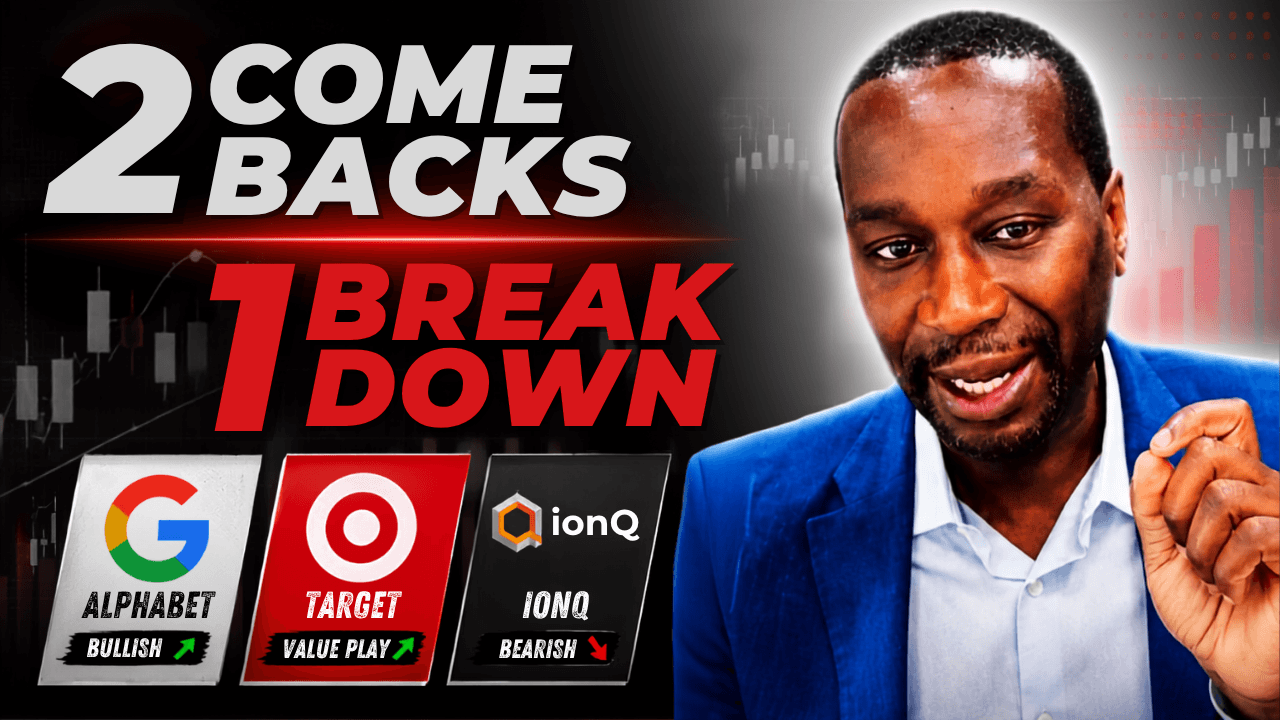
During my latest appearance on Schwab Network’s The Big 3, I shared my current outlook on the overall market and introduced three potential trades involving Google, Target, and IonQ.
These 3 stocks represent very different opportunities. Two are potential bullish trades built around longer-term strength, while the third is a bearish setup in a highly speculative area of the market.
The goal is not to predict the future with certainty. It is to identify the trend, develop a strategy, define the risk, and prepare for multiple outcomes.
The Market Is at a Pivotal Point
When I look at the S&P 500, I remain bullish over the long term. In the short term, however, I am more skeptical.
The market has been trading within a wedge pattern, repeatedly approaching resistance while producing lower highs. At the same time, the recent move toward the top of that range has not been supported by a meaningful increase in trading volume.
We are also moving through earnings season, when company results, forecasts, spending plans, and management commentary can quickly change investor sentiment. Even a company that reports good numbers can see its stock decline if expectations were already too high.
That is why I believe the market may be due for a reset or short-term pullback.
This does not mean there are no opportunities. It means traders may need to look beyond the index, examine each stock individually, and remain flexible enough to consider both bullish and bearish strategies.
With all of that in mind, watch the video below and be sure to download the full trade report, too
Potential Trade No. 1: Google / Alphabet (GOOGL)
Google is one of the companies I believe is well positioned to benefit from the continued growth of artificial intelligence.
The company has several different ways to monetize its technology and AI investments, including:
-Google Search and AI-generated search results
-Google Cloud
-Gemini subscriptions
-Google Workspace
-YouTube advertising
-Data centers and AI infrastructure
That ecosystem is a major advantage.
Many companies are still trying to determine how they will distribute and monetize their AI products. Google already owns several of the platforms consumers and businesses use every day.
The strategy I discussed in the video gives the trade additional time to develop beyond the company’s upcoming earnings report. That extra time matters because earnings can create significant short-term volatility, even when the long-term thesis remains intact.
The full video explains the option expiration, strike price, breakeven point, upside thesis, and the price level that would cause me to reconsider the setup.
Potential Trade No. 2: Target (TGT)
Target offers potential diversification away from technology, semiconductors, and the Magnificent Seven. More importantly, the company has recently shown improvement across multiple areas of its business, including food and beverage, household products, apparel, toys, beauty, and its digital and membership-related services.
That suggests the company’s recovery may be broader than a temporary improvement in one product category.
The stock has also been steadily trending higher from its lows. Its shorter-term moving averages are above the longer-term averages, and the chart has been developing within an upward-sloping price channel.
This does not mean the stock will move straight up.
Target may require patience. The potential trade is designed around the idea of a slower, longer-term move rather than an immediate breakout. The strategy provides the stock with enough time to work through temporary pullbacks while attempting to participate in a continued recovery.
Potential Trade No. 3: IonQ
The third opportunity takes a completely different approach.
Rather than looking for another bullish trade, I wanted to identify a stock that may offer downside potential.
IonQ operates in the developing quantum-computing industry. The technology has the potential to support complex applications such as pharmaceutical research, cybersecurity, financial modeling, cryptography, and advanced material development.
However, promising technology does not automatically guarantee a successful stock.
The larger question is whether there is currently enough sustainable demand from commercial customers to support IonQ’s valuation and future growth expectations. Investors must also consider what could happen if larger technology companies eventually introduce lower-cost alternatives or make quantum-computing capabilities more widely available through cloud platforms.
The chart is also showing signs of weakness.
IonQ formed what appears to be a double-top pattern and has been moving lower within a downward price channel. Its shorter-term moving averages have crossed below longer-term averages, and the stock has already broken beneath an important high-volume trading area.
Unlike the Alphabet and Target strategies, this bearish trade uses less time because stocks often fall much faster than they rise.
Three Stocks, Three Different Thought Processes
The bigger lesson is not simply whether Google rises, Target continues recovering, or IonQ moves lower.
The lesson is that every stock requires its own analysis.
Alphabet represents a potential long-term technology and AI opportunity supported by a powerful ecosystem.
Target represents a recovery and diversification opportunity in an established retail business.
IonQ represents a bearish opportunity in a speculative company facing both technical weakness and questions about future demand.
These trades also demonstrate why you should not approach every opportunity with the same expiration date, strike price, or strategy. The amount of time selected should match how quickly you expect the move to develop. The strategy should match the direction, volatility, and risk associated with the stock.
Most importantly, every setup needs an “I’m wrong” level.
Before entering a trade, it’s good to know what price movement or change in the chart would invalidate your original thesis. That level helps you manage risk and prevents one idea from turning into an uncontrolled loss.
Disclaimer: Trading stocks and options involves substantial risk and can result in the loss of some or all of your invested capital. The information in this article, video, and accompanying report is provided for educational and informational purposes only and should not be considered financial, investment, or trading advice. Past performance does not guarantee future results. You are responsible for evaluating your own financial situation, knowledge, experience, and risk tolerance before placing any trade.