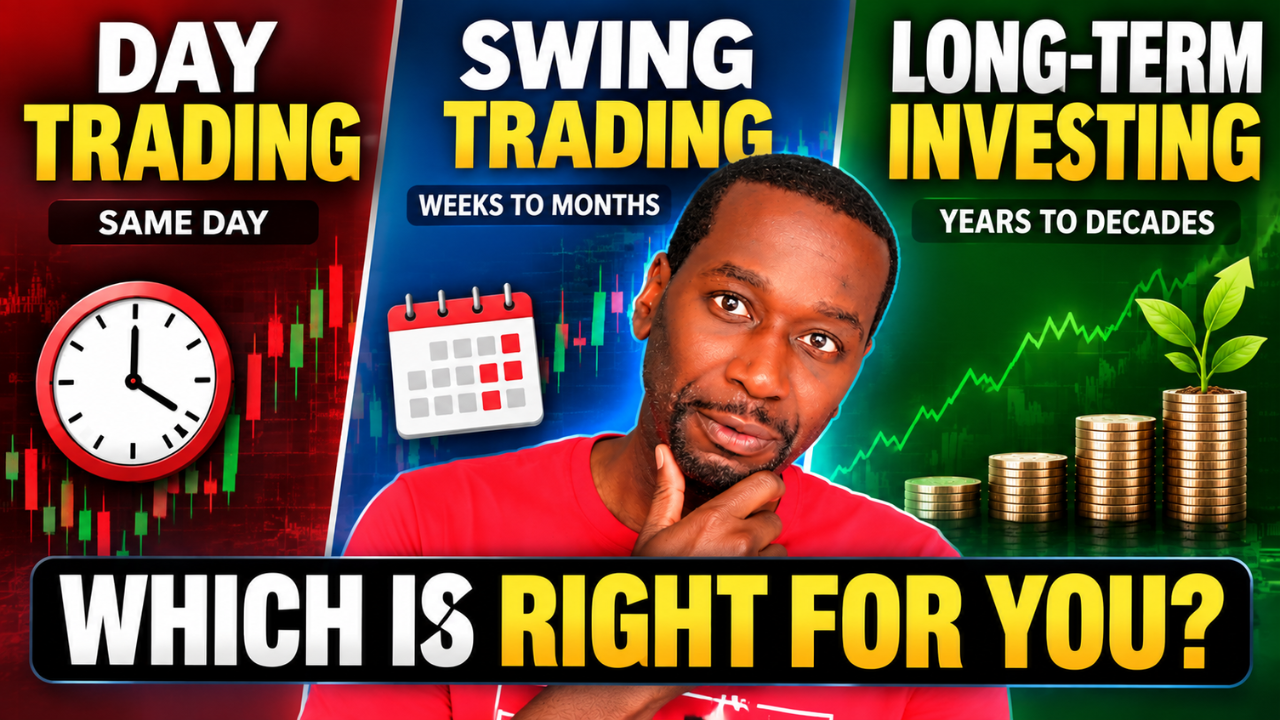
Day Trading, Swing Trading or Long-Term Investing: Which Fits You?
Most people choose a trading style by asking one question:
Which one can make me the most money?
I think there’s a better question: Which one actually fits my life?
Day trading, swing trading, and long-term investing all require different amounts of time, attention, risk tolerance, and decision-making. The right choice depends less on what looks exciting and more on what fits your lifestyle, personality, capital, and goals.
Watch the video below to help you decide.
1. How Much Time Can You Give the Market?
Day trading requires the most attention. You’re entering and exiting trades during the same day, often watching short-term charts and making decisions quickly.
Swing trading gives you more flexibility. Trades may last weeks or months, allowing you to participate in the market without sitting in front of a screen all day.
Long-term investing requires the least day-to-day attention because you’re focused on where a company or investment may be years from now.
The key is to be realistic about how much time you actually have.
2. What Fits Your Personality?
Your personality matters more than most traders realize.
If you enjoy fast decisions and constant market activity, day trading may appeal to you. But that pace can also create more stress.
Swing trading worked better for me when I had a full-time job because I could participate in the market without needing to watch every move.
Long-term investing may fit someone who prefers patience, less frequent decision-making, and allowing investments more time to develop.
Your trading style should fit your temperament, not fight against it.
3. How Much Capital Do You Have?
Starting with a smaller account doesn’t automatically mean you should day trade.
Someone with $500 may choose to add money consistently and invest for the long term. Someone with $5,000 may have a shorter-term goal and decide swing trading better fits that objective.
Your starting capital matters, but so do your timeline, experience, and reason for investing.
4. How Much Risk Can You Handle?
Risk looks different depending on your time frame.
Day trading involves frequent decisions in a short window, which can increase the opportunity for mistakes.
Swing trading gives a position more time to develop and allows you to focus on a broader trend instead of every daily fluctuation.
Long-term investing can smooth out some short-term market noise, but long-term does not mean set it and forget it.
Companies and industries change. Even long-term investors need to monitor their investments and know when the original thesis is no longer working.
5. What Are Your Financial and Lifestyle Goals?
Maybe your goal is to build long-term wealth, save for a home, or develop a skill that could eventually produce additional income.
But your goals shouldn’t only be financial.
Do you have a family, a full-time job, or other responsibilities?
When I started, I wanted my money working for me while I was still working my job. I wanted to participate in the stock market and build wealth without creating a strategy that required me to be in front of a computer all day.
That’s why swing trading made sense for me.
You Don’t Have to Pick Just One
You don’t have to stay in one category forever.
You might invest long-term in a retirement account while swing trading with a smaller portion of your money. You may also try day trading and realize that a longer time frame fits you better.
That’s essentially what happened to me. I started with shorter-term trading and eventually realized that many of the moves I was trying to capture every day could have been captured by simply zooming out and giving them more time.
Today, I’m much more of a swing trader and long-term investor.
Which Style Fits You?
Think of it this way.
Consider day trading if you enjoy watching the market closely, have the time to be present during the trading day, and can make quick decisions without letting emotion take over.
Consider swing trading if you want to participate more actively in the market but need your strategy to fit around a job, family, or other responsibilities.
Consider long-term investing if your main goal is building wealth over time and you’re comfortable allowing investments to develop over years instead of days or months.
There is no universal answer.
The best choice is the one that fits your time, personality, capital, risk tolerance, goals, and lifestyle.
The biggest mistake is choosing a trading style because someone else made it look exciting or profitable.
The market has to fit into your life. Not the other way around.
And remember, your answer can change. As your experience grows, your financial situation changes, and your life evolves, your investing strategy can evolve with it.